/// Share this article
Website: Motherhood Fertility & IVF — motherhoodivf.com
Industry: Fertility / IVF / Reproductive Medicine
Investigated by: Vikas Solanke | Web Design Bangalore
Audit type: SEO, technical SEO, information architecture, content, internal linking and website-forensics analysis
Evidence reviewed: Current homepage source code, April 2025 historical snapshot, current indexed pages, location architecture, doctor pages, blog architecture and visible search footprint.
Audit date: October 2026
Important note: This is an independent website-forensics analysis based on publicly accessible website data and an archived version of the website. It is not an allegation that any particular website change caused the ranking decline. Search visibility is influenced by many variables, including content, links, technical signals, competition and Google’s algorithmic systems. The objective here is to identify changes that deserve investigation.
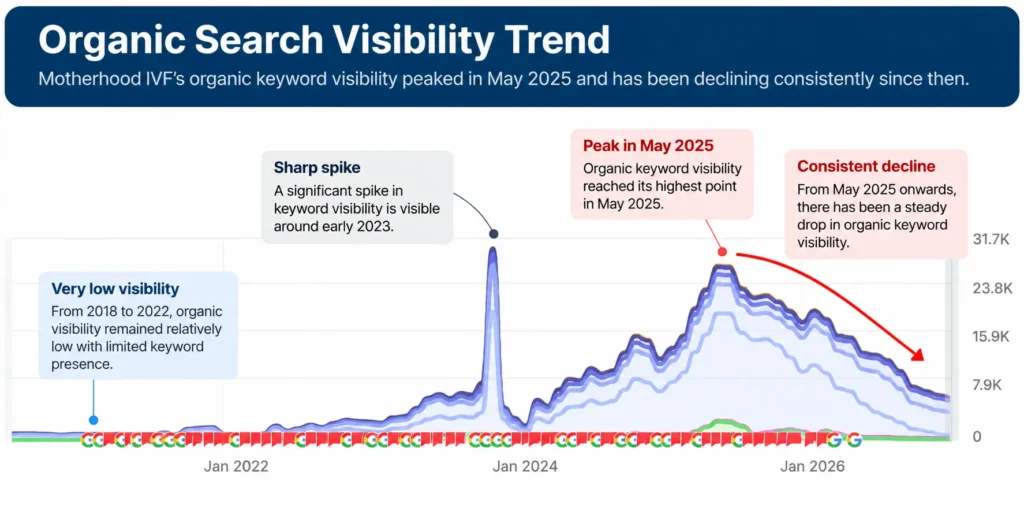
Executive Summary
Motherhood Fertility & IVF is not a small local fertility clinic with a handful of pages.
It is a large multi-location fertility brand with dedicated treatment pages, location pages, doctor profiles, educational content and appointment infrastructure. Its current website states that fertility care is available across 19 locations in India. Motherhood Fertility & IVF Centre
That makes its organic search architecture particularly important.
A fertility website at this scale is effectively a digital network of:
- treatment pages
- condition pages
- location pages
- doctor profiles
- educational content
- FAQs
- conversion pages
- internal links connecting all of those entities
The interesting part of this investigation is what happened to that network.
The April 2025 archived homepage and the current homepage are structurally very different.
The older homepage was built around a highly explicit search architecture. Its metadata targeted phrases such as “Best IVF Center,” “Fertility Treatment Clinic,” “IVF,” “IUI” and “ICSI.” It also contained a large internal-linking section connecting the homepage to location-specific pages using phrases such as “Best IVF Center in Bangalore,” “Best Fertility Hospital in Chennai,” “IVF Treatment Cost in Bangalore,” “Best Male Infertility Clinic in Bangalore” and many others. web.archive.org-source(1) web.archive.org-source(1)
The current website has taken a different approach.
The homepage now emphasizes a broader brand proposition:
“More Than a Fertility Centre: A Complete Journey to Parenthood”
and focuses heavily on comprehensive care, pregnancy, childbirth, neonatal care, compassion, technology and patient experience. Motherhood Fertility & IVF Centre
That positioning is not inherently wrong.
In fact, from a branding perspective, it is arguably stronger.
But from an SEO perspective, the transition creates a critical question:
Did the redesign remove or weaken some of the explicit topical and internal-link signals that previously connected Motherhood’s homepage to its high-value commercial and local search ecosystem?
My analysis suggests that this is one of the most important areas to investigate.
There are also several technical and architectural changes worth examining:
| Area | Earlier website | Current website | Audit assessment |
|---|---|---|---|
| WordPress theme | Neve | Custom motherHood2025 theme | Major architecture change |
| Homepage page ID | 85 | 113770 | Major rebuild |
| Page builder | Elementor/Neve ecosystem | Custom theme + Elementor ecosystem | Major change |
| H1 | Present, although hidden in the archived markup | No clear homepage H1 found in the fetched current homepage | High priority |
| Homepage topical focus | IVF/fertility/location/search terms | Broader parenthood journey | Needs SEO balancing |
| Location internal linking | Very extensive | Much more restrained | High priority |
| Homepage internal URL destinations | Approximately 107 unique internal paths in the archived source | Approximately 76 in the current source | Potential authority-flow reduction |
| Metadata | Strong IVF/fertility keyword targeting | Still commercially relevant | Not the main concern |
| Schema | WebPage, ImageObject, BreadcrumbList, WebSite | WebPage, ImageObject, WebSite, Organization | Generally improved |
| Technical stack | Older WordPress/Neve/Elementor stack | Custom theme + Elementor + numerous plugins/scripts | Performance audit required |
| Locations | Older architecture referenced 15 centres / 9 cities | Current site states 19 locations | Expansion should strengthen, not weaken, local architecture |
| Content | Heavy keyword/location architecture | More brand and experience-led | Potential relevance trade-off |
The key takeaway is simple:
The problem may not be that Motherhood changed its website. The problem may be that the website changed what it was telling search engines about its topical relationships.
That distinction matters.
How This Investigation Was Conducted
I approached this as a website-forensics investigation rather than a conventional SEO audit.
That means I did not start with a checklist of title tags and meta descriptions.
Instead, I compared the website as it existed before the major transformation with what is publicly visible today.
The investigation included:
- archived HTML from April 24, 2025
- current homepage source code
- metadata comparison
- heading structure
- homepage content
- internal-link architecture
- location-page architecture
- treatment/service architecture
- doctor-page architecture
- blog architecture
- technical asset loading
- JavaScript dependencies
- schema implementation
- visible indexation patterns
- current location coverage
- current appointment architecture
The archived homepage was captured by the Wayback Machine on April 24, 2025, with the page metadata indicating a modification date of April 8, 2025. web.archive.org-source(1)
The current homepage’s structured data identifies it as a page published on December 10, 2025 and modified on August 11, 2026. www.motherhoodivf.com-source
That gives us an important forensic window.
The archived version is not necessarily the exact version that existed on the day the visibility decline began. Therefore, this investigation should not claim that the April-to-current comparison alone proves causality.
Instead, it gives us two highly useful snapshots of the site’s evolution.
The First Major Finding: This Was Not a Cosmetic Redesign
One of the most important things visible in the source code is that Motherhood did not simply change colours, images and layouts.
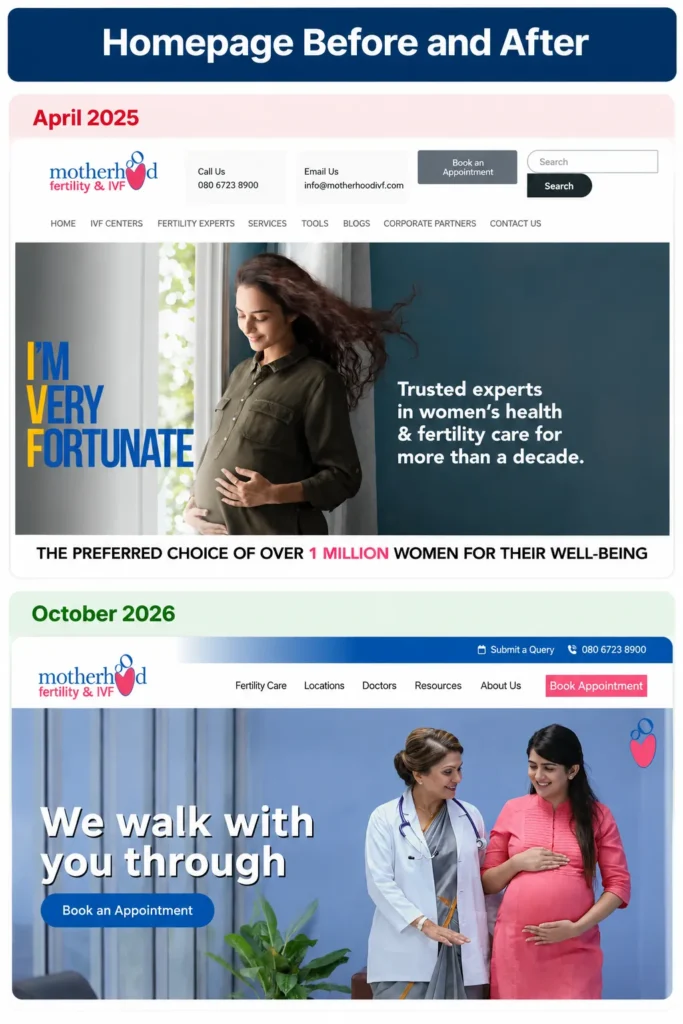
The underlying implementation changed substantially.
The archived homepage identifies itself as:
<body class="home ... page-id-85 wp-theme-neve ... elementor-page-85">The current homepage identifies itself as:
<body class="home ...
page-id-113770
wp-custom-logo
wp-theme-motherHood2025
theme-motherHood2025
woocommerce-no-js
...
elementor-page-113770">
The archived source therefore represents a page running on the older Neve + Elementor architecture, while the current homepage is running on a custom motherHood2025 theme architecture. web.archive.org-source(1) www.motherhoodivf.com-source
That is a significant migration.
A migration of this scale should always be treated as an SEO event.
When a site moves from one architecture to another, the question isn’t simply:
“Did the pages load?”
The correct question is:
“Did Google receive the same semantic, internal-link, URL, canonical and content signals after the migration?”
Those are very different questions.
The Old Homepage Was Much More Explicit About What Motherhood Wanted to Rank For
The archived homepage title was:
<title>
Best IVF Center & Fertility Treatment Clinic in India |
Motherhood Fertility & IVF Centers
</title>
Its meta description explicitly referenced:
advanced infertility treatments including IUI, ICSI, IVFand its structured data carried the same positioning. web.archive.org-source(1)
This is important because the homepage wasn’t merely presenting the brand.
It was explicitly establishing a topical relationship between:
Motherhood → IVF → fertility treatment → infertility → IUI → ICSI → India
That doesn’t mean Google ranks a page simply because those words appear in the title.
It means the entire page architecture was reinforcing that subject.
The Old Homepage Had an H1 — and the Current Homepage Presents a Different Heading Structure
The archived homepage contained this H1:
<h1 class="elementor-heading-title elementor-size-default">
Best IVF Centre/Clinic In India For Men & Women
</h1>
Interestingly, the Elementor element was configured as hidden across desktop, tablet and mobile. web.archive.org-source(1)
That is not ideal implementation.
But technically, an H1 existed in the source.
The current homepage, on the other hand, is structured around headings such as:
Reasons to choose Motherhood Fertility & IVF
More Than a Fertility Centre: A Complete Journey to Parenthood
When science meets compassion, miracles happen
Ovulation Calculator
Period Calculator
Locate the nearest Motherhood Fertility & IVF
Frequently Asked Questions
The current homepage’s visible content is substantially more brand-led and experience-led. Motherhood Fertility & IVF Centre
That creates an obvious SEO question:
Where is the single, unmistakable primary subject of the homepage?
For a website competing in a highly commercial YMYL category, I would want the homepage’s primary heading to make the entity and service relationship immediately obvious.
For example:
<h1>Motherhood Fertility & IVF — Fertility & IVF Care in India</h1>The exact wording should be determined through keyword and brand research, but the structural principle is straightforward:
The homepage should not make Google infer the primary subject.
The Biggest Content Change Is Not Less Content — It Is Different Content
This is where the audit gets more interesting.
A superficial audit might say:
“The old website had more keywords.”
That is true, but it is not the complete story.
The old homepage was much more aggressive in connecting the homepage to commercial search concepts.
The current homepage is much better at communicating the broader brand promise.
For example, the current homepage explains:
- IVF
- IUI
- ICSI
- female fertility
- male fertility
- infertility counselling
- advanced treatments
- second opinions
- fertility preservation
- high-risk delivery
- neonatal care
- pregnancy journey
The current site also has a dedicated fertility-centres directory and doctor ecosystem. Motherhood Fertility & IVF Centre
So this is not a case of the website becoming empty.
It is a case of the site’s semantic emphasis changing.
That distinction is critical.
The Old Homepage Had a Massive Internal-Linking Network
This may be the most important finding in the entire audit.
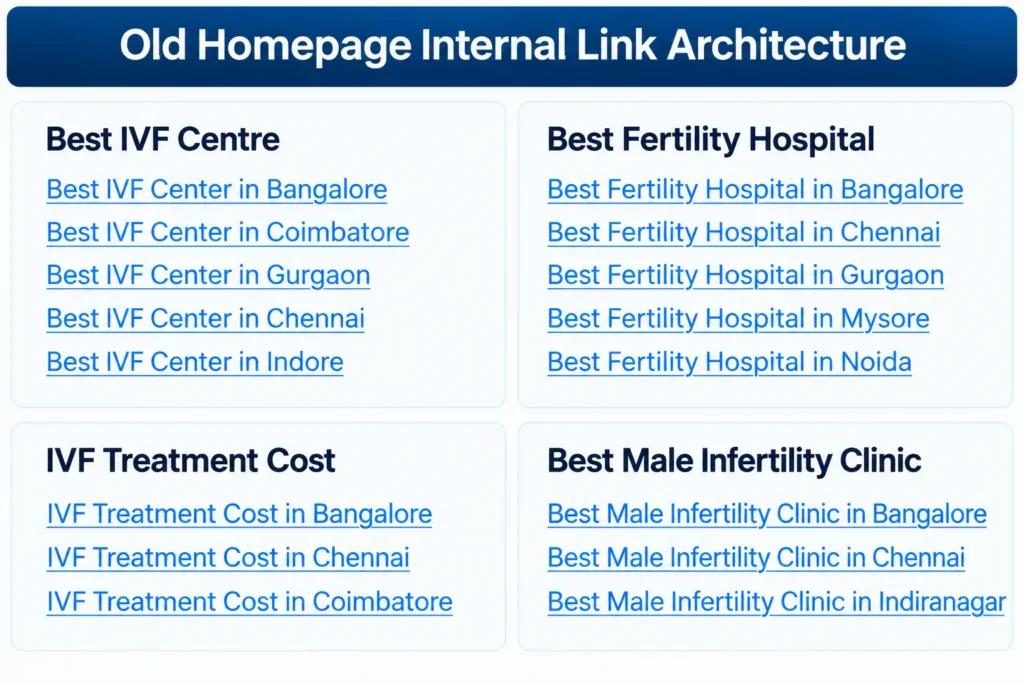
Near the bottom of the archived homepage was an enormous internal-link block.
It contained groups such as:
- Best IVF Centre
- Best Fertility Hospital
- Best Fertility Centre
- IVF Treatment Cost
- Best IVF Clinic
- Best IVF Hospital
- Best Infertility Hospital
- Best Infertility Clinic
- Best Female Infertility Clinic
- Best Male Infertility Clinic
Those sections then linked to individual location pages.
For example:
<a href="/best-ivf-center-in-bangalore/">
    Best IVF Center in Bangalore
</a>
and:
<a href="/best-fertility-ivf-centre-in-coimbatore/">
    Best Fertility Center in Coimbatore
</a>
The archived source contains this architecture across numerous cities and neighbourhoods. web.archive.org-source(1) web.archive.org-source(1)
This is a very different internal-linking philosophy from the current homepage.
The old homepage essentially acted as a search-oriented hub.
The current homepage acts more like a brand-oriented landing page.
That may look cleaner.
But SEO isn’t a design competition.
Why Internal Linking Matters So Much for a Multi-Location IVF Brand
Imagine Motherhood has:
- 19 locations
- dozens of doctors
- dozens of treatments
- fertility conditions
- procedures
- educational articles
- city pages
- neighbourhood pages
That’s a large semantic graph.
Google needs to understand how those pages relate to one another.
A simplified model looks like this:
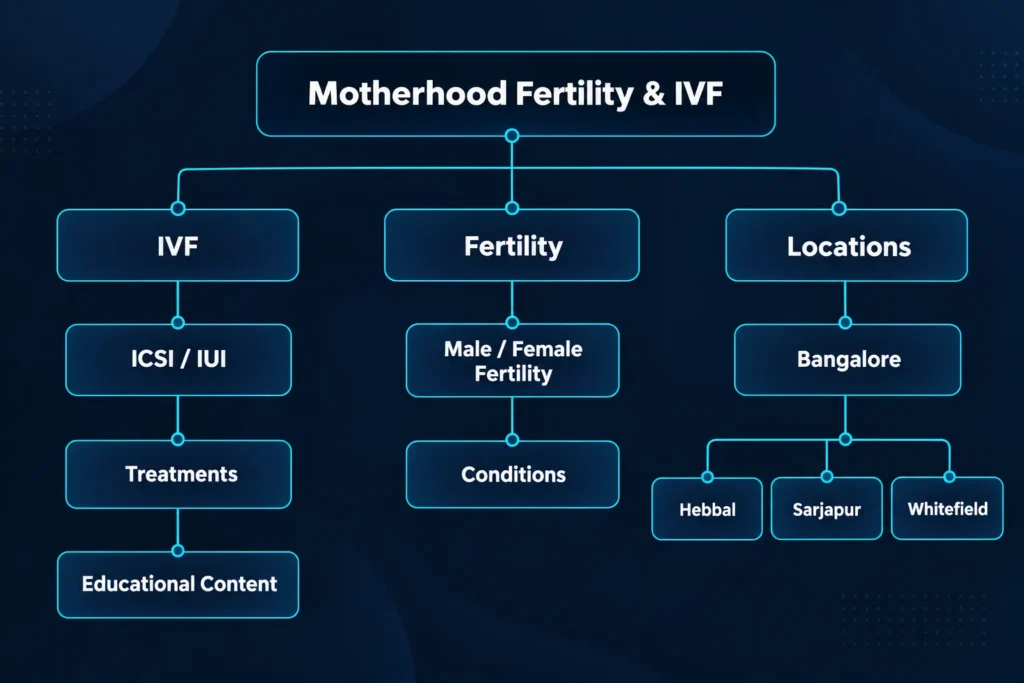
The homepage is one of the strongest possible places to reinforce those relationships.
The old architecture did this aggressively.
The current site still has the underlying content, but much of the relationship is now distributed across navigation, location pages and other templates.
That is not necessarily wrong.
But if the old homepage was helping Google understand the entire commercial network, reducing those relationships during a migration could matter.
The Old Homepage Was Essentially Building a Local SEO Matrix
This deserves special attention.
The old page wasn’t merely linking to Bangalore.
It linked to:
- Bangalore
- Coimbatore
- Gurgaon
- Chennai
- Sarjapur
- Indiranagar
- HRBR Layout
- Hebbal
- Electronic City
- Chandigarh
- Banashankari
- Mysore
- Noida
- Indore
- Navi Mumbai
- Mohali
And it combined these locations with commercial intent terms.
For example:
Best IVF Center in Bangalore
Best IVF Center in Coimbatore
Best Fertility Hospital in Gurgaon
IVF Treatment Cost in Chennai
Best IVF Hospital in Hebbal
Best Female Infertility Clinic in Bangalore
Best Male Infertility Clinic in Indiranagar
The archived source demonstrates how extensive this matrix was. web.archive.org-source(1) web.archive.org-source(1)
Again, I would not recommend bringing that exact keyword wall back.
It is too repetitive for a modern homepage and creates a poor user experience.
But I would absolutely preserve the underlying SEO architecture.
What I Would Replace the Old Keyword Wall With
Instead of 1,000+ words of repetitive anchor text, I would build a clean internal-link system.
For example:
| Topic | Recommended hub | Example links |
|---|---|---|
| IVF | IVF Treatment | IVF, ICSI, IUI, FET |
| Fertility | Fertility Services | Male fertility, female fertility |
| Conditions | Fertility Conditions | PCOS, recurrent miscarriage, infertility |
| Locations | IVF Centres | Bangalore, Chennai, Gurgaon, Pune |
| Bangalore | Bangalore IVF Centres | Hebbal, Sarjapur, Whitefield, Indiranagar |
| Doctors | Fertility Specialists | Doctor profiles |
| Cost | IVF Cost | IVF treatment cost, consultation cost |
| Patient education | IVF Blog | Treatment guides, FAQs, recovery |
| Conversion | Appointment | Book appointment / callback |
The homepage can then contain natural links such as:
Explore our fertility and IVF treatments
Find a Motherhood Fertility & IVF centre near you
Meet our fertility specialists
Understand IVF treatment and costs
That gives Google the relationships without turning the homepage into an anchor-text catalogue.
The Current Location Architecture Is Actually Stronger in One Important Respect
There is an important positive development that should not be overlooked.
The current website says it has 19 locations across India.
The current location directory includes centres such as:
- Banashankari
- Electronic City
- Hebbal
- HRBR Layout
- Indiranagar
- Kothanur
- Sarjapur
- Whitefield
- Jeevan Bhima Nagar
- Chennai
- Coimbatore
- Gurgaon
- Indore
- Mohali
- Navi Mumbai
- Mysore
- Noida
- Pune
and others.
So Motherhood has not abandoned local SEO.
In fact, it has expanded its physical footprint.
The question is whether the homepage and site-wide internal-link architecture adequately distribute that location authority.
That is a much more productive question.
Location Pages Are Now an Important SEO Asset
The current location pages contain useful commercial and informational content.
For example, the Banashankari page identifies the centre, address, phone number, services, positioning and surrounding areas.
The Jeevan Bhima Nagar page similarly provides location information and treatment categories, including male fertility tests, female fertility tests, advanced treatments and second opinions.
This is good.
But these pages should be treated as a structured location network rather than a collection of isolated landing pages.
The Doctor Architecture Is Another Major Opportunity
The current website has a dedicated doctor directory.
The doctor pages include:
- name
- qualification
- location
- experience
- speciality
- appointment functionality
The doctor directory currently exposes specialists across multiple locations.
Individual doctor pages can therefore become significant organic landing pages.
For example, the current site has doctor pages containing information such as:
Consultant – Reproductive Medicine
MBBS, MS, DNB, FICOG
10+ Years Experience
Languages
Locations
Book an Appointment
Book Video Consultation
That is exactly the type of entity-level information a large healthcare site should be building around.
The next step is to make the relationships explicit:
Doctor
   ↓
Speciality
   ↓
Treatment
   ↓
Location
   ↓
Condition
   ↓
Appointment
That is a much stronger semantic network than simply having hundreds of independent pages.
The Current Homepage’s Broader Brand Positioning Is Good — But It Should Not Replace Search Intent
One of the current site’s strongest messages is:
“More Than a Fertility Centre: A Complete Journey to Parenthood”
The page then explains its focus on sustainable pregnancies, baby’s health and care from conception to birth and beyond.
From a brand perspective, that’s compelling.
The problem would arise if the website assumes that brand positioning and search intent are the same thing.
They aren’t.
A patient searching:
IVF centre in Bangalore
has a different intent from someone searching:
fertility hospital near me
and different intent again from:
IVF treatment cost in Bangalore
and:
IVF specialist in Hebbal
and:
recurrent IVF failure treatment
A strong website needs to serve all of those journeys.
The homepage should establish the entity.
The service pages should establish the treatments.
The location pages should establish geographical relevance.
The doctor pages should establish expertise.
The articles should establish topical authority.
And the internal links should connect the whole system.
The Metadata Was Changed — But Metadata Is Probably Not the Main Problem
The current title is:
<title>
Fertility Clinic: Best IVF & Fertility Center in India |
Motherhood Fertility & IVF Centre
</title>
The current meta description states:
Fertility Clinic: Motherhood Fertility & IVF Centre is the best IVF center
in India for infertility issues offering IVF, IUI, ICSI treatments.
Find the best fertility center near me.
The canonical is:
<link rel="canonical" href="https://www.motherhoodivf.com/" />So the current metadata is not obviously broken.
In fact, the title still contains:
- Fertility Clinic
- IVF
- Fertility Center
- India
The description still contains:
- IVF
- infertility
- IUI
- ICSI
- fertility centre
Therefore, I would not make “bad meta title” the headline finding.
The deeper changes are happening elsewhere.
The Schema Implementation Has Improved in Some Areas
The archived homepage’s structured data included:
- WebPage
- ImageObject
- BreadcrumbList
- WebSite
The current homepage includes:
- WebPage
- ImageObject
- WebSite
- Organization
The current WebPage also references the Organization entity as its about and publisher relationship. www.motherhoodivf.com-source
That’s a positive architectural change.
However, schema should be viewed as a representation of the site’s entities, not as an SEO shortcut.
The bigger question is whether the underlying page architecture is equally clear.
The Technical Stack Is Heavier Than It First Appears
This is another area I would investigate before making any performance claims.
The current homepage source loads a substantial collection of assets and third-party dependencies.
The source includes, among other things:
- Elementor
- Premium Addons
- JetPopup
- Elementskit
- Bootstrap
- Font Awesome
- Slick Carousel
- Ionicons
- AOS animation library
- custom theme JavaScript
- blog search JavaScript
- testimonial load-more JavaScript
- news load-more JavaScript
- WhatsApp functionality
- Cloudflare Turnstile
- external customer/lead widgets
For example, the current source loads Bootstrap 5.3.7, Font Awesome 6.5.2, Slick Carousel, Ionicons and AOS. www.motherhoodivf.com-source
It also loads JetPopup and Elementskit-related JavaScript. www.motherhoodivf.com-source
This doesn’t automatically mean the site is slow.
That’s an important distinction.
Source code complexity is not the same thing as poor Core Web Vitals.
Actual performance should be measured with:
- Lighthouse
- PageSpeed Insights
- CrUX
- Chrome DevTools
- mobile throttling
- real-user data
But the source tells us something useful:
There are enough moving parts here to justify a serious performance audit.
There Is Also a Mixture of Custom Theme Code and Page Builder Infrastructure
The current site identifies itself as a custom motherHood2025 theme but continues to use Elementor infrastructure. www.motherhoodivf.com-source
That combination can work perfectly well.
But over time it can create an interesting maintenance problem:
Custom Theme
      +
Elementor
      +
Elementskit
      +
Premium Addons
      +
JetPopup
      +
Contact Form Extensions
      +
Custom JS
      +
Third-party JS
      =
More rendering and dependency complexity
Again, this is an investigation point, not proof of a ranking problem.
The next step should be measuring what actually reaches the browser.
The Current Website Has a Much Better Educational Content Opportunity Than the Old Homepage
One area where Motherhood appears to be moving in the right direction is its content publishing.
The current blog architecture contains a substantial body of fertility-related content, with categories covering areas such as:
- IVF Treatment Journey
- IVF Procedures & Techniques
- Embryo Transfer
- IUI Treatment
- Fertility Preservation
- Ovarian Reserve & Egg Health
- Male Fertility & Sperm Health
- Female Fertility & Conception
- Infertility Causes & Diagnosis
- Reproductive Health Conditions
- Fertility Tests & Diagnostics
- Diet, Nutrition & Lifestyle
- Emotional Wellbeing
- Myths, Facts & FAQs
The current blog directory shows 146 posts in its displayed category count.
That is a substantial topical asset.
There are also recent articles authored by named medical professionals, such as Dr. Shruti N Mane and Dr. Amitha N.
That is particularly important for a medical/YMYL website.
This Is Where E-E-A-T Can Become a Competitive Advantage
A fertility website should not try to win simply by publishing more articles.
It should demonstrate why the information deserves trust.
The current site already has an opportunity to do that through:
- named doctors
- qualifications
- speciality
- experience
- locations
- medical authorship
- treatment pages
- patient FAQs
- clinical explanations
- centre information
For example, the current doctor directory explicitly lists qualifications and locations for specialists.
That should be expanded into a consistent editorial system.
Every medically important article should ideally make it obvious:
Who wrote it?
Who medically reviewed it?
What are their qualifications?
Where do they practise?
When was the article reviewed?
What sources were used?
When should the patient consult a specialist?
This is much more valuable than simply adding the phrase “medically reviewed” to a page.
The Appointment Journey Is Also Worth Studying
The current site has a dedicated appointment page.
It allows users to either:
- request a callback
- book online
- select a location
- choose a fertility specialist
- proceed with appointment booking
The appointment page also explicitly lists conditions and services for which users can request consultations.
This is a good conversion architecture.
But there is an SEO opportunity here as well.
The commercial landing pages should have extremely clear paths into the appointment system.
For example:
IVF Treatment
      ↓
IVF Specialist
      ↓
Nearest Centre
      ↓
Doctor
      ↓
Appointment
and:
IVF Treatment Cost
      ↓
Cost Factors
      ↓
Consultation
      ↓
Nearest Centre
      ↓
Appointment
The visitor should never have to figure out the next step.
The Biggest Migration Question: What Happened to the Old URLs?
This is one of the areas I would investigate before declaring the audit complete.
Whenever a major website architecture changes, the following questions need to be answered for every commercially important old URL:
| Question | Why it matters |
|---|---|
| Does the old URL still exist? | Determines whether content was retained |
| Does it return 200, 301, 404 or another status? | Determines crawl and migration behaviour |
| If redirected, where does it redirect? | Determines relevance preservation |
| Does the new page have a canonical? | Prevents conflicting URL signals |
| Was the old URL in the sitemap? | Indicates indexation strategy |
| Does the new page retain the old topic? | Determines relevance continuity |
| Are internal links updated? | Preserves crawl paths and authority flow |
| Did backlinks point to the old URL? | Determines migration risk |
| Did rankings move from old URL to new URL? | Determines whether migration succeeded |
This is especially important for a site with hundreds of commercial and location pages.
A single redirect spreadsheet can reveal more than hours of generic SEO auditing.
The Website’s Local SEO Architecture Should Be Treated as a Network
Motherhood currently has an opportunity that many smaller fertility clinics simply don’t have.
It has multiple physical locations.
The location directory confirms 19 locations.
That means the site can establish a powerful local hierarchy:
India
│
├── Bangalore
│   ├── Hebbal
│   ├── Sarjapur
│   ├── Whitefield
│   ├── Indiranagar
│   ├── Electronic City
│   ├── HRBR Layout
│   ├── Kothanur
│   ├── Banashankari
│   └── Jeevan Bhima Nagar
│
├── Chennai
├── Coimbatore
├── Gurgaon
├── Indore
├── Mohali
├── Navi Mumbai
├── Mysore
├── Noida
└── Pune
That architecture should be reflected not just in a dropdown.
It should be reflected in:
- navigation
- location hubs
- internal links
- breadcrumbs
- doctor pages
- treatment pages
- FAQs
- local landing pages
- Google Business Profiles
- structured data
- contextual content
The Bangalore Architecture Is Particularly Important
Bangalore is clearly one of Motherhood’s largest local clusters.
The current site exposes multiple Bangalore locations including:
- Electronic City
- Banashankari
- Hebbal
- HRBR Layout
- Indiranagar
- Kothanur
- Sarjapur
- Whitefield
- Jeevan Bhima Nagar
The current Bangalore page also presents centre-level information and doctor information.
That creates an opportunity to build a true Bangalore fertility hub.
For example:
/best-ivf-center-in-bangalore/
        |
        +-- /best-fertility-ivf-centre-in-hebbal/
        +-- /best-fertility-ivf-centre-in-sarjapur/
        +-- /best-fertility-ivf-centre-in-whitefield/
        +-- /best-fertility-ivf-centre-in-indiranagar/
        +-- /best-fertility-ivf-centre-in-electronic-city/
        +-- /best-fertility-ivf-centre-in-hrbr/
        +-- /best-fertility-ivf-centre-in-kothanur/
        +-- /best-fertility-ivf-centre-in-banashankari/
Then connect those pages to:
IVF treatment
IUI
ICSI
Male fertility
Female fertility
Fertility preservation
IVF specialists
IVF cost
Book appointment
That is the sort of structure I would want to see from a large multi-location fertility brand.
The Old Homepage’s Keyword Density Was Not the Solution — Its Architecture Was
This is an important distinction.
I would not recommend Motherhood simply put the old keyword wall back.
For example, repeating:
Best IVF Center in Bangalore | Best IVF Center in Chennai | Best IVF Center in Gurgaon…
over and over is not a sophisticated SEO strategy.
It is a relic of an older SEO mindset.
But the underlying architecture was useful.
The modern version should look more like:
Find a Motherhood Fertility & IVF Centre near you
Then:
Bangalore
- Hebbal
- Sarjapur
- Whitefield
- Indiranagar
- Electronic City
- HRBR Layout
- Kothanur
- Banashankari
- Jeevan Bhima Nagar
Other cities
- Chennai
- Coimbatore
- Gurgaon
- Indore
- Mohali
- Navi Mumbai
- Mysore
- Noida
- Pune
That gives users something useful while simultaneously strengthening the internal-link graph.
The Current Site Has an Interesting Content Duplication Risk to Watch
There is another issue that should be checked systematically.
When a large multi-location site creates hundreds of local pages, those pages can become extremely similar.
For example:
Motherhood Fertility & IVF, Hebbal
Motherhood Fertility & IVF, Sarjapur
Motherhood Fertility & IVF, Whitefield
Motherhood Fertility & IVF, Electronic City
If every page contains essentially the same:
- introduction
- service list
- doctor description
- fertility paragraph
- FAQ
- CTA
with only the location name changed, the site may create a large collection of pages that are technically different URLs but semantically very similar.
The current Jeevan Bhima Nagar, Hebbal and Sarjapur pages show a common structural pattern around fertility services, male/female fertility tests, advanced treatments and second opinions.
That isn’t automatically a problem.
But at scale, each location page needs enough genuine local differentiation to justify its existence.
What a Strong Location Page Should Contain
I would build each location page around real local information:
| Element | Recommendation |
|---|---|
| Centre name | Exact entity |
| Address | Exact physical address |
| Phone | Centre-specific |
| Doctors | Doctors actually practising there |
| Qualifications | Doctor-level E-E-A-T |
| Treatments | Location-specific availability |
| Facilities | Actual centre facilities |
| Nearby areas | Genuine catchment areas |
| Directions | Useful navigation |
| Parking/access | If applicable |
| FAQs | Location-specific |
| Reviews | Genuine reviews |
| Photos | Real centre photography |
| Appointment CTA | Direct conversion |
| Related treatments | Contextual internal links |
| Related doctors | Contextual internal links |
| Related locations | Useful nearby alternatives |
That produces a page worth ranking.
Not just a page worth indexing.
The Blog Should Feed the Commercial Pages
The current blog has a large amount of educational content.
The mistake many large medical websites make is allowing the blog to become an island.
For example:
Blog Article
     ↓
Related treatment
     ↓
Doctor
     ↓
Location
     ↓
Appointment
A patient reading:
What Is IVF?
should have contextual links to:
- IVF treatment
- IVF specialists
- IVF centres
- IVF cost
- appointment
Someone reading:
IVF Treatment Cost in India
should be able to move to:
- IVF consultation
- treatment options
- doctors
- centres
Someone reading:
Recurrent IVF Failure
should be able to discover:
- second opinion
- fertility specialists
- relevant diagnostics
- appointment
The blog shouldn’t just generate traffic.
It should distribute relevance and commercial intent throughout the site.
The Current Blog Has an E-E-A-T Opportunity That Should Be Taken Much Further
The current website is already publishing medically attributed content.
For example, an IVF cost article is attributed to Dr. Shruti N Mane, including medical qualifications.
Another IVF article is attributed to Dr. Amitha N, identified as a consultant in reproductive medicine.
That is a good foundation.
But I would build a standard medical editorial framework:
Written by:
Dr. ______
Qualification:
MBBS, MD...
Speciality:
Reproductive Medicine
Location:
Motherhood Fertility & IVF, ______

Medically reviewed by:
Dr. ______

Last reviewed:
October 2026

Medical disclaimer:
...
That is far more convincing than generic author boxes.
The Site Should Make Its Expertise Visible Before the User Has to Search for It
The current site says it has 300+ years of combined experience on its About page.
That is potentially a powerful trust signal.
But claims like this should be supported with a clear entity structure.
Instead of simply saying:
300+ years of combined experience
the site could make the expertise discoverable:
300+ years combined clinical experience

120+ fertility specialists
19 locations
X embryologists
X fertility specialists
X years of fertility care
Only where those numbers can be verified.
The point is not to add impressive numbers.
The point is to make the organization’s expertise auditable.
What I Would Change on the Homepage
If I were responsible for the SEO architecture, I would not throw away the new homepage.
I would improve it.
The current brand direction is stronger than the old keyword-heavy design.
The solution is to combine both approaches.
The homepage should establish five things very quickly:
| Priority | Homepage question |
|---|---|
| 1 | Who are you? |
| 2 | What do you specialise in? |
| 3 | Where are you located? |
| 4 | Why should I trust you? |
| 5 | What should I do next? |
A stronger hierarchy would be:
H1
Motherhood Fertility & IVF — Fertility & IVF Care in India

Supporting proposition

Why Motherhood

Treatments

Male Fertility

Female Fertility

Advanced Treatments

Doctors

Locations

Patient Stories

Educational Resources

FAQs

Appointment CTA
The exact copy should be tested, but the architecture should be this clear.
Recommended Homepage H1
A potential implementation could be:
<h1>
Motherhood Fertility & IVF — Fertility & IVF Care in India
</h1>
Alternative:
<h1>
Fertility & IVF Care at Motherhood Fertility & IVF
</h1>
I would validate the final wording against current keyword demand, competitor SERPs and brand positioning before implementation.
The important thing is that the homepage has one obvious primary subject.
Recommended Homepage Internal Linking
Instead of recreating the old keyword wall, I would add a clean navigation block.
For example:
<section class="fertility-navigation">

  <h2>Explore Fertility & IVF Care</h2>

  <ul>
    <li><a href="/ivf/">IVF Treatment</a></li>
    <li><a href="/iui/">IUI Treatment</a></li>
    <li><a href="/icsi/">ICSI Treatment</a></li>
    <li><a href="/male-fertility-services/">Male Fertility</a></li>
    <li><a href="/female-fertility-services/">Female Fertility</a></li>
    <li><a href="/fertility-preservation/">Fertility Preservation</a></li>
    <li><a href="/doctors/">Fertility Specialists</a></li>
    <li><a href="/ivf-centers/">Our Fertility Centres</a></li>
    <li><a href="/book-appointment/">Book an Appointment</a></li>
  </ul>

</section>
Then a separate location section:
<section class="location-navigation">

  <h2>Find a Motherhood Fertility & IVF Centre Near You</h2>

  <h3>Bangalore</h3>

  <ul>
    <li><a href="/best-fertility-ivf-centre-in-hebbal/">Hebbal</a></li>
    <li><a href="/best-fertility-ivf-centre-in-sarjapur/">Sarjapur</a></li>
    <li><a href="/best-fertility-ivf-centre-in-whitefield/">Whitefield</a></li>
    <li><a href="/best-fertility-ivf-centre-in-indiranagar/">Indiranagar</a></li>
  </ul>

</section>
The actual URLs should obviously be validated before deployment.
The Current Website Has a Strong Opportunity Around Search Intent
The website can be mapped into four major intent groups.
| Search intent | Example | Ideal page |
|---|---|---|
| Informational | What is IVF? | Blog/guide |
| Commercial investigation | IVF treatment cost | Cost page |
| Local commercial | IVF centre in Bangalore | Location page |
| Transactional | Book IVF consultation | Appointment page |
The problem occurs when one page attempts to serve all four.
The solution is a connected architecture where each page has a clear job.
The Recommended SEO Architecture
I would structure the site approximately like this:
HOME
│
├── TREATMENTS
│   ├── IVF
│   ├── IUI
│   ├── ICSI
│   ├── FET
│   ├── Blastocyst Transfer
│   ├── PGS / PGD
│   └── Fertility Preservation
│
├── FERTILITY
│   ├── Female Fertility
│   ├── Male Fertility
│   ├── Infertility Diagnosis
│   └── Fertility Conditions
│
├── DOCTORS
│   ├── Doctor profiles
│   └── Specialty/location relationships
│
├── CENTRES
│   ├── Bangalore
│   │   ├── Hebbal
│   │   ├── Sarjapur
│   │   ├── Whitefield
│   │   └── ...
│   ├── Chennai
│   ├── Coimbatore
│   └── ...
│
├── IVF COST
│
├── BLOG
│   ├── Treatment
│   ├── Conditions
│   ├── Diagnostics
│   ├── Fertility Preservation
│   └── Patient Education
│
└── BOOK APPOINTMENT
That is a scalable architecture.
The Internal Linking Model Should Then Look Like This
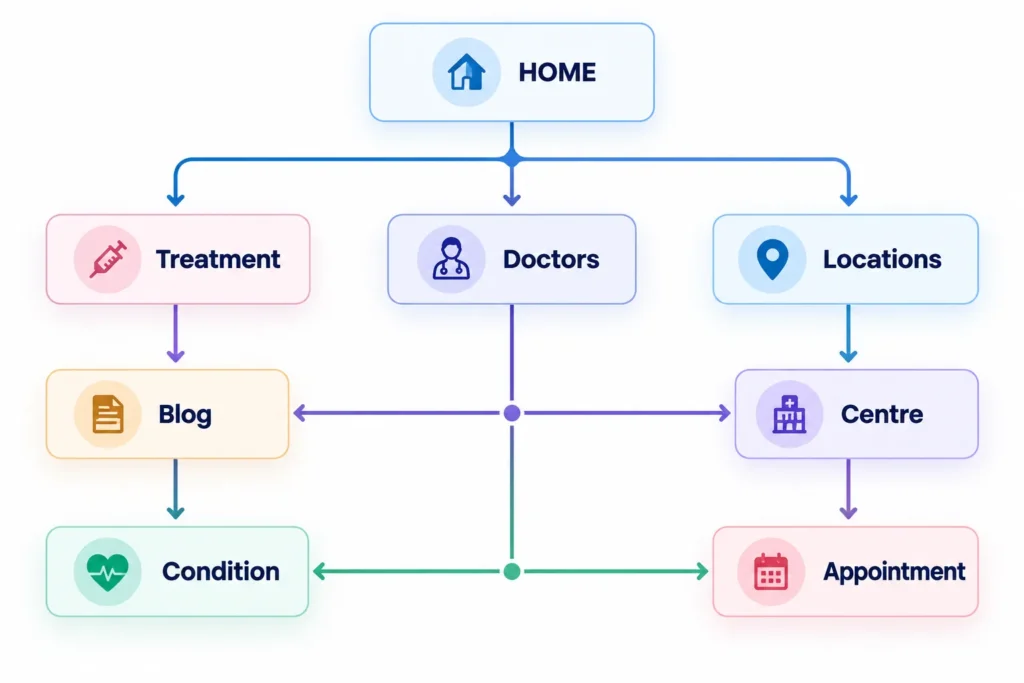
Every major page should have at least two directions of contextual movement.
Not just:
“Read more.”
But:
“Looking for a fertility specialist in Bangalore? Meet our fertility doctors.”
That’s useful to humans.
And useful architecture for search engines.
The Current Site’s FAQ Strategy Can Also Be Improved
The homepage currently contains a Frequently Asked Questions section.
That’s useful, but I wouldn’t put every possible question on the homepage.
Instead, FAQs should be distributed according to search intent.
For example:
IVF page
- What is IVF?
- Who may need IVF?
- How long does IVF take?
- How many visits are required?
IVF cost page
- What affects IVF cost?
- Are medicines included?
- Are tests included?
- Can IVF costs vary between patients?
Location page
- Where is the centre?
- What doctors practise there?
- What treatments are available?
- How do I book?
Doctor page
- What conditions does the doctor treat?
- What qualifications do they have?
- Where do they consult?
- How do I book?
That produces a much cleaner information architecture.
The Site Should Not Chase “Best IVF Centre” Everywhere
This is another place where restraint matters.
Motherhood has historically used phrases such as:
Best IVF Centre
Best Fertility Hospital
Best IVF Hospital
Best Infertility Clinic
The archived homepage shows just how extensively these terms were used across location combinations. web.archive.org-source(1) web.archive.org-source(1)
I would not build the new architecture around repeating “best” everywhere.
A stronger strategy is to demonstrate why the organisation deserves consideration:
- doctors
- qualifications
- facilities
- treatments
- technology
- locations
- experience
- patient information
- outcomes where legitimately supportable
- transparent explanations
- appointment access
Authority should be demonstrated, not declared repeatedly.
What the Website Should Do With Its Existing 19 Locations
The 19-location footprint is an SEO asset.
But each location needs a clear role.
I would create a location audit spreadsheet containing:
| Location | URL | Indexed? | Canonical | H1 | Unique Content | Doctors | Reviews | Internal Links | GBP | Status |
|---|---|---|---|---|---|---|---|---|---|---|
| Hebbal | Add URL | ✓ | ✓ | ✓ | High | ✓ | ✓ | Strong | ✓ | Keep |
| Sarjapur | Add URL | ✓ | ✓ | ✓ | Medium | ✓ | ✓ | Medium | ✓ | Improve |
| Whitefield | Add URL | ? | ? | ? | Low | ✓ | ✓ | Low | ✓ | Audit |
| Electronic City | Add URL | ? | ? | ? | Medium | ✓ | ✓ | Medium | ✓ | Audit |
Note: ✓ Verified/present | ? Requires verification. Scroll horizontally on smaller screens to view all columns.
This would immediately expose weak pages.
The Redirect Audit Should Be One of the First Technical Actions
For every old commercial URL, create:
Old URL
↓
HTTP status
↓
Redirect destination
↓
Destination relevance
↓
Canonical
↓
Indexability
↓
Internal links
↓
Backlinks
↓
Current rankings
A redirect to the homepage is not automatically a successful migration.
A redirect from:
/best-fertility-ivf-centre-in-hebbal/to:
/is very different from redirecting it to:
/best-fertility-ivf-centre-in-hebbal/or its genuinely relevant replacement.
This is where a URL-by-URL migration audit becomes extremely valuable.
Performance Needs a Real Measurement, Not a Guess
The current source contains enough dependencies to justify investigation, but I would not publish a claim such as:
“The new site is slow and that caused the rankings to fall.”
That would be irresponsible without measurements.
Instead, measure:
| Metric | Desktop | Mobile |
|---|---|---|
| LCP | Measure | Measure |
| INP | Measure | Measure |
| CLS | Measure | Measure |
| TTFB | Measure | Measure |
| Total JS | Measure | Measure |
| Total CSS | Measure | Measure |
| Image payload | Measure | Measure |
| Third-party requests | Measure | Measure |
Then compare:
Current homepage vs major competitors.
That gives us evidence.
The Current Source Also Reveals Multiple Third-Party Dependencies
The source includes integrations for:
- Cloudflare Turnstile
- customer/lead widget
- analytics/tracking
- Google Tag Manager
- external JS/CDN resources
- form processing
For example, the current page contains Google Tag Manager, Cloudflare Turnstile and WhatsApp-related functionality. www.motherhoodivf.com-source www.motherhoodivf.com-source
Again, these are not inherently bad.
But every third-party dependency should have a reason.
The question is:
How much of the user’s first render depends on code that isn’t actually necessary to understand or use the page?
That is a performance engineering question worth answering.
The Homepage Should Be Designed for Both Search Engines and Humans
The old homepage leaned heavily toward search engines.
The current homepage leans more heavily toward humans and brand experience.
The next version should do both.
That means:
Clear entity
+
Clear service
+
Clear location
+
Clear expertise
+
Clear evidence
+
Clear internal links
+
Clear conversion path
That is the sweet spot.
What I Believe Happened
Based on the evidence reviewed, my working hypothesis is:
Motherhood’s website transformation improved the brand presentation and expanded the broader fertility-care story, but the migration appears to have materially changed the way the site’s commercial, topical and local relationships were expressed.
The most important areas are:
- Loss/change of the old homepage’s explicit search-focused architecture.
- Removal/reduction of the massive location and commercial internal-link network.
- Change from the older Neve/Elementor homepage to a custom
motherHood2025architecture. - Lack of an obvious homepage H1 in the current fetched page.
- Redistribution of content and search intent across the newer architecture.
- Potential migration/redirect/canonical issues that need URL-level validation.
- Increased technical complexity that warrants a Core Web Vitals investigation.
- A large location-page network that needs systematic quality and uniqueness review.
- A growing medical-content ecosystem that needs even stronger author/reviewer/entity connections.
None of these alone proves why rankings changed.
Together, however, they form a very strong investigation trail.
What I Would Fix First
If I were given access to the website’s Google Search Console, GA4 and server logs, this would be my priority order.
| Priority | Action | Why |
|---|---|---|
| 1 | Full URL migration audit | Find lost/redirected/indexation URLs |
| 2 | Compare GSC queries before/after migration | Identify which intent groups declined |
| 3 | Rebuild internal-link architecture | Restore topical relationships |
| 4 | Fix homepage H1/entity clarity | Establish primary topic |
| 5 | Audit location pages | Prevent thin/duplicated local architecture |
| 6 | Audit canonical/indexability | Remove conflicting signals |
| 7 | Rebuild commercial intent hubs | IVF, IUI, ICSI, cost, conditions |
| 8 | Strengthen doctor entities | Build medical E-E-A-T |
| 9 | Connect blog → treatment → doctor → location | Turn informational traffic into authority flow |
| 10 | Measure Core Web Vitals | Establish whether technical performance is contributing |
| 11 | Audit structured data | Ensure entity relationships are accurate |
| 12 | Improve conversion pathways | Turn organic visibility into consultations |
The Most Important Data I Would Request From Motherhood
If this were a paid forensic investigation, I would ask for the following data.
Google Search Console
- 16 months of queries
- pages
- countries
- devices
- search appearance
- clicks
- impressions
- CTR
- average position
Most importantly:
Compare the period before the redesign with the period after the redesign.
Then group queries into:
IVF
IUI
ICSI
Fertility
Infertility
Cost
Doctors
Locations
Conditions
Treatments
Brand
That would tell us exactly which part of the site’s search footprint changed.
Google Analytics
Compare:
- organic landing pages
- engagement
- appointment conversions
- location pages
- doctor pages
- blog traffic
- treatment traffic
A ranking loss matters much more if it coincides with loss of high-value organic conversions.
The Search Console Analysis Could Change the Diagnosis Completely
This is worth stressing.
Suppose GSC shows:
IVF queries ↓ 60%
Location queries ↓ 15%
Doctor queries ↑ 40%
Blog queries ↑ 80%
That tells a very different story from:
Everything ↓ 50%The first scenario suggests an intent/architecture problem.
The second could point toward a broader technical, authority, algorithmic or migration problem.
Without GSC, we can identify the evidence and formulate hypotheses.
We cannot honestly claim causation.
That distinction is what separates a real forensic audit from a generic SEO report.
The Bigger Lesson for Large Healthcare Websites
There is a lesson here that extends far beyond Motherhood.
Large healthcare websites often evolve in this direction:
SEO website
      ↓
Brand redesign
      ↓
Cleaner UX
      ↓
Less keyword-heavy content
      ↓
Simpler navigation
      ↓
Important internal relationships disappear
      ↓
Organic visibility becomes harder to maintain
The answer isn’t to go backwards.
The answer is to build a website that understands both worlds.
A modern healthcare website should be:
brand-first in presentation
while remaining:
entity-first, intent-first and architecture-first underneath.
That means the patient sees:
compassionate care
while Google sees:
organization → specialty → treatment → doctor → location → condition → educational resource → appointment
Both can exist on the same website.
My Recommended Motherhood SEO Model
If I were rebuilding the information architecture today, this would be the model:
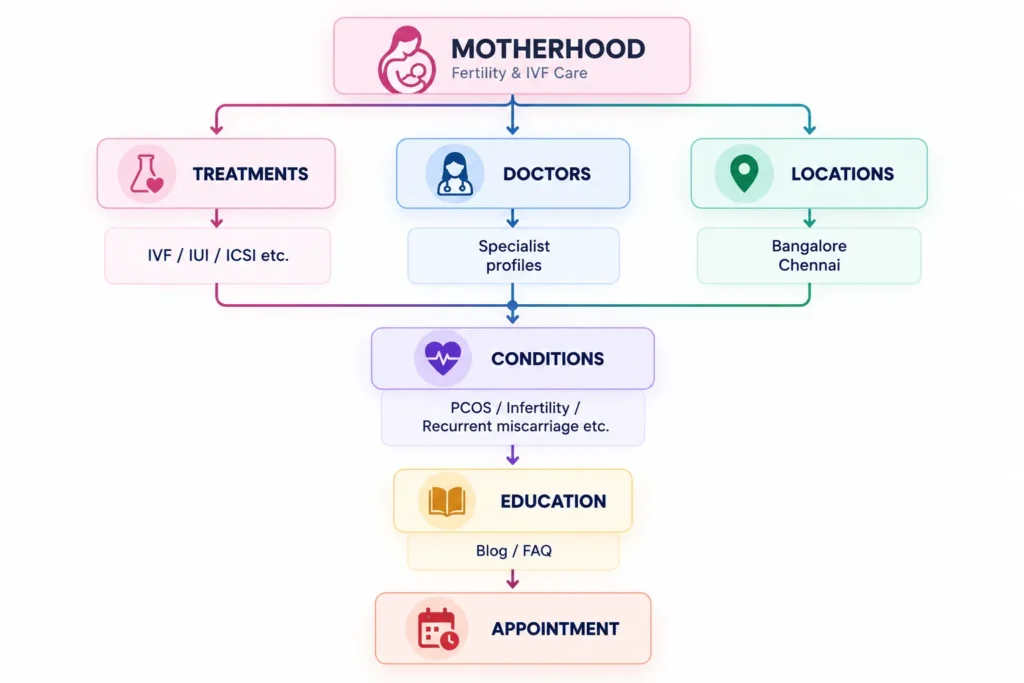
That is the architecture I would want the entire site to reinforce.
The good news is that the underlying assets are still there.
Motherhood already has:
the locations.
the doctors.
the treatments.
the expertise.
the content.
the brand.
the appointment infrastructure.
What needs attention is the architecture connecting them.
That is where I would start.
Audit Conclusion
A website redesign is successful when the new website looks better without becoming less understandable to search engines.
For a large IVF organisation, that means preserving the connections between:
brand → expertise → treatment → condition → doctor → location → content → appointment.
Motherhood has most of those pieces.
The forensic question is whether the redesign preserved the connections between them.
Based on the source-code comparison and current website architecture reviewed for this investigation, that is the area I would investigate first.
And if the objective is to recover lost organic visibility, I would not begin by stuffing more keywords into the homepage.
I would begin with the URLs.
Then the redirects.
Then Search Console.
Then the internal-link graph.
Then the location architecture.
Then the treatment/condition relationships.
Then E-E-A-T.
And only after that would I start rewriting copy.
Because when a large website loses search visibility after a major transformation, the most important clues are often hiding in the architecture, not in the words on the page.
Evidence note
The archived homepage reviewed for this investigation was captured on April 24, 2025. The current homepage’s structured data identifies a December 2025 publication date and an August 2026 modification date.
The current Motherhood website publicly identifies 19 fertility locations and maintains dedicated location, doctor, treatment, appointment and educational-content sections.
Audit methodology: This article distinguishes directly observed source-code changes from analytical interpretation. A ranking decline cannot be attributed to a single website change without access to historical Search Console, analytics, backlink and server data.
/// Share this article
/// More web design reading